Fiber laser power — how many kilowatts do you really need?
The power of the laser source decides how thick a material the machine can handle and how fast it cuts. We explain what 6 kW means versus 20 kW, how power relates to thickness and cutting speed, and why more kilowatts is not always better.
When choosing a laser cutting supplier, the question of source power sooner or later comes up — 6 kW, 12 kW, or up to 20 kW? The power of a fiber laser determines how thick a material the machine can cut and how fast. It is not the only number that matters, though, and more kilowatts do not automatically mean a better result.
What does laser power (kW) mean?
Kilowatts express how much optical power the laser source can deliver to the cutting head. Higher power means more energy concentrated at the cut — the material melts or vaporizes faster. In practice this shows up in two ways: the machine can cut thicker material and, at the same thickness, it cuts at a higher speed.
Common industrial fiber lasers today range from 3 kW to 30 kW. Machines up to 6 kW cover most standard production of thin and medium sheet; 12–20 kW sources are made for thick materials and high productivity.
Power vs. material thickness
The most visible effect of power is the maximum thickness that can be reliably cut. Rough values for common materials (actual limits depend on the assist gas, edge quality, and the machine):
- 6 kW: carbon steel up to about 20 mm, stainless up to 15 mm, aluminium up to 12 mm
- 12 kW: carbon steel up to 30 mm, stainless up to 40 mm, aluminium up to 30 mm
- 20 kW: carbon steel up to 40 mm, stainless up to 50 mm, aluminium up to 40 mm
For very thick steel (above 40–50 mm) a combination with oxygen or plasma cutting often pays off — the fiber laser loses its economic edge there.
Power vs. cutting speed
On medium and thicker sheet, higher power is a direct time saving: a 20 kW source cuts 15 mm steel considerably faster than a 6 kW machine. On large batches this difference translates straight into the cost per part.
Thin sheet (up to ~3 mm) is different. There the speed is no longer limited by laser power but by the dynamics of the machine — how fast the gantry accelerates and decelerates in corners and small features. That is why 20 kW does not cut thin sheet five times faster than 4 kW; the difference is small and the drives and motion control decide.
6 kW or 20 kW? Our machines
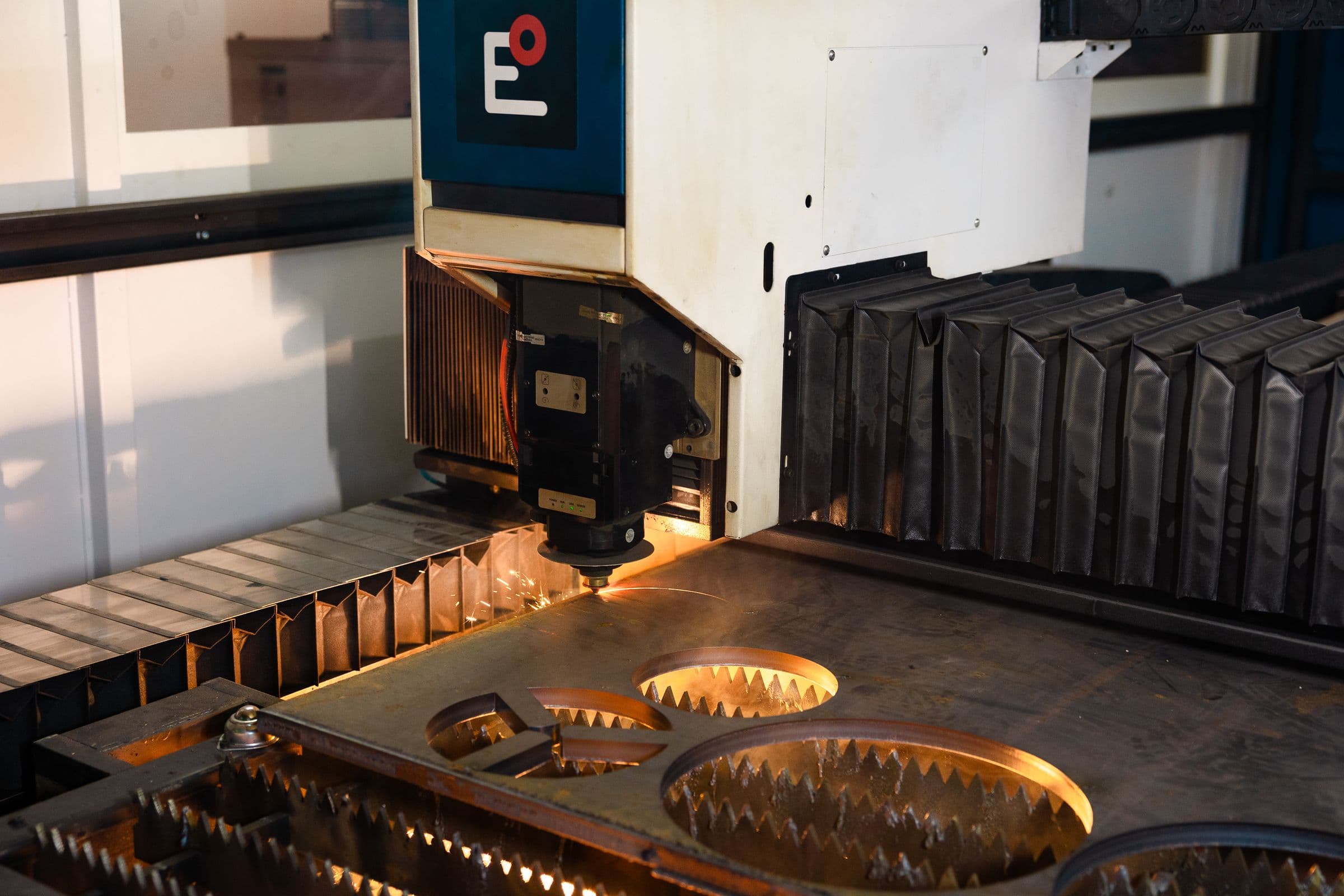
In our machine park we use both approaches depending on the job. The Wattsan 1530, rated up to 6 kW with a 1500 × 3000 mm bed, is ideal for standard sheet, prototypes, and smaller series. The Wattsan 2040, rated up to 20 kW with a 2000 × 4000 mm bed, handles thicker materials, larger formats, and demanding series production.
This lets us run every order on the machine that produces it most efficiently — thin parts on the compact laser, thick and large ones on the powerful one. See the Technology page for a detailed overview.
Why more kW is not always better
- Energy consumption: a more powerful source draws more power — on thin sheet it may not be used to the full.
- Heat input: more energy means more heat; on sensitive materials the process has to be set up correctly.
- Return on investment: if you do not cut thick sheet in large batches, high power may not pay off economically.
Correctly chosen power is therefore about the balance between material thickness, production volume, and cost — not about the highest possible number.
Conclusion
Laser power determines what the machine can cut and how fast, but the ideal value depends on your production. For thin and medium sheet 6 kW is enough; for thick materials and high productivity 20 kW makes sense. If you are not sure, send us a drawing or DXF — we will propose the most suitable solution and prepare a quote right away.