Laser vs. waterjet vs. plasma — which cutting method to choose
Laser, waterjet, and plasma are the three most common ways to cut sheet metal, yet each shines in a different area. We compare them on precision, thickness range, material range, edge quality, speed, and cost — and show when each one fits.
When you need to cut a part from sheet metal, the choice usually comes down to three technologies: laser, waterjet, and plasma. All three can separate material without a mechanical tool, but they differ in precision, thickness and material range, edge quality, and cost. This article compares them and shows when each one fits.
The three methods at a glance
Each method works on a different principle. The laser melts and vaporizes material with a narrow, focused beam of light. The waterjet mechanically erodes it with a stream of water and abrasive under extreme pressure. Plasma melts the metal with an electric arc inside a jet of ionized gas. Their strengths and weaknesses follow directly from these principles.
Laser — precise, narrow kerf, clean edge
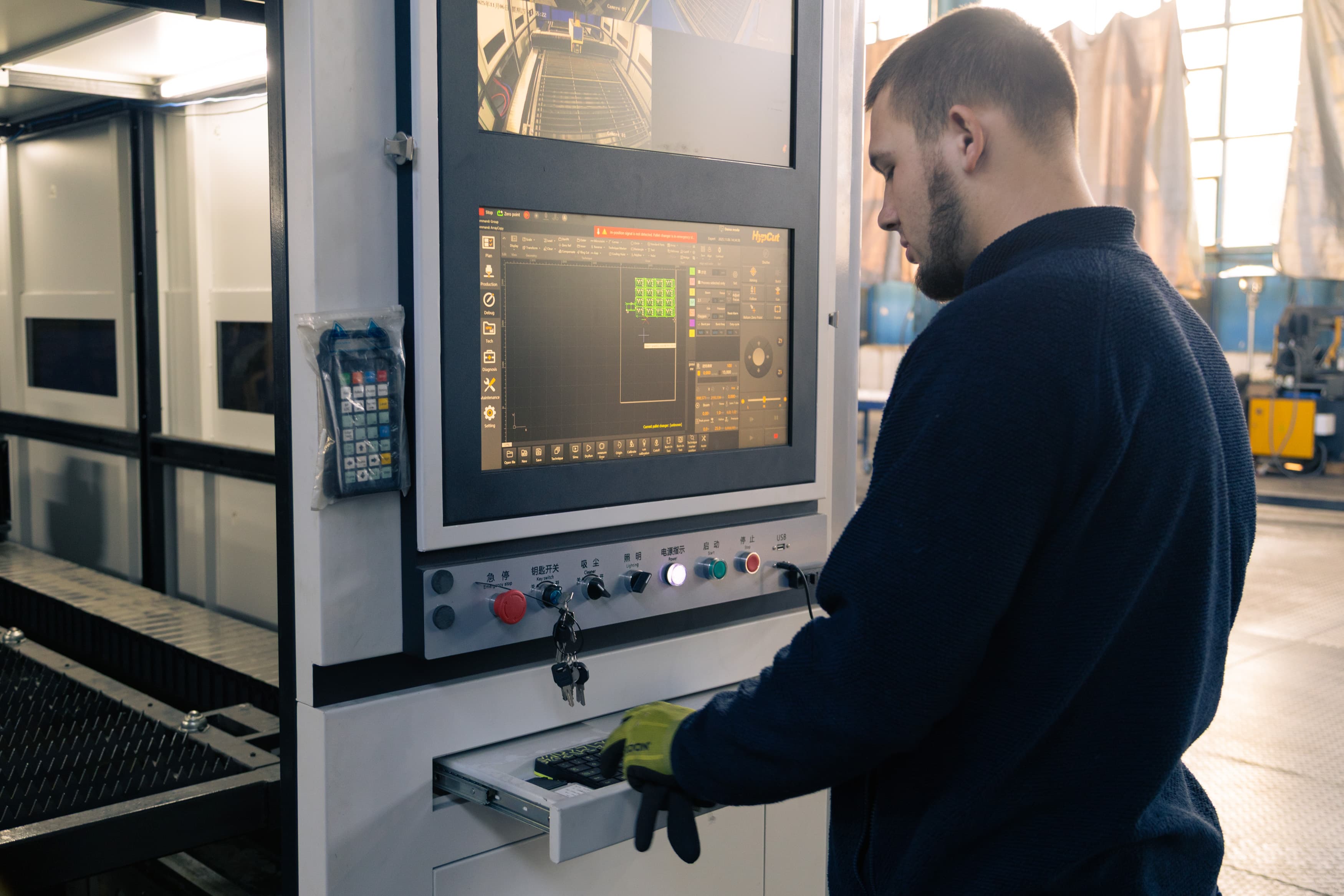
The fiber laser is the most precise of these methods. The beam creates a very narrow kerf, so details, small holes, and sharp corners come out faithfully and repeatably. The edge is smooth and nearly square, and on thin to medium sheet it cuts very fast. Its limits are maximum thickness — on common steel roughly up to 20–25 mm — and a heat-affected zone, which is nonetheless narrow.
- Highest precision and the narrowest kerf of the compared methods
- Clean, nearly square edge with minimal finishing needed
- Very fast on thin to medium sheet
- Limited maximum thickness and unsuitable for non-conductive materials such as glass or stone
Waterjet — no heat, almost any material
The waterjet cuts cold — there is no heat-affected zone, so the material keeps its properties and the edge does not deform. It handles extreme thicknesses (even over 100 mm) and almost anything: metal, stone, glass, composites, and rubber. The trade-off is lower speed, a wider kerf than the laser, and a wet process with abrasive that raises operating costs.
- No heat-affected zone — no distortion or change in structure
- Cuts very thick parts and non-metals (glass, stone, composites)
- Slower and wider kerf, a wet process with abrasive
- Higher operating cost and parts need cleaning after the cut
Plasma — fast and cheap on thick conductive plate
Plasma is fast and economical on thicker conductive metals where high precision is not required. On structural steel it cuts briskly and cheaply, but at the cost of a rougher edge, a wider kerf, and a more pronounced heat-affected zone. It suits thick plate that will be machined further anyway. Non-conductive materials cannot be cut with plasma.
- Fast and cheap cutting of thick conductive plate
- Rougher edge, wider kerf, and a larger heat-affected zone
- Only electrically conductive metals (steel, stainless, aluminium)
- Lower precision — suited where further machining follows
Which method for which job
The choice depends on the priority — precision, thickness, material, or cost:
- Precision and detail on thin to medium sheet — laser
- Very thick parts or non-metals without heat (glass, stone) — waterjet
- Thick conductive plate as cheaply and quickly as possible — plasma
- Best balance of precision, speed, and edge quality for everyday sheet-metal parts — laser
Conclusion — for most sheet-metal parts, laser is the best choice
Waterjet and plasma have their place: waterjet for extreme thicknesses and non-metals, plasma for cheap cutting of thick plate. For the vast majority of sheet-metal parts, however, the laser offers the best balance of precision, speed, edge quality, and cost. That makes it the number-one all-round choice — and it is exactly what we offer.