Why laser cutting leaves unusable material offcuts
In laser cutting the price does not depend on cut length alone — how efficiently the sheet is used matters just as much. We explain why irregular shapes and large cut-outs (a ring, for example) leave unusable offcuts, the role of the 1.5 × thickness edge clearance, and the handling, storage and disposal costs that scrap brings.
In laser cutting the price of a job is not set by cutting time or piece count alone. How efficiently the sheet the part is cut from gets used matters just as much. The shape of the part therefore has a direct impact not only on material consumption, but also on the amount of scrap, the handling in production and the total cost of the job.
Every part is cut from a specific piece of sheet
When production is set up, a suitable material format is chosen for the part — most often a rectangular or square piece of sheet. The required shape is then cut out of this blank with the laser.
With simple, compact shapes the use of the material tends to be more efficient. But if a part has an irregular shape, or contains large internal cut-outs, a greater amount of offcuts is left after cutting — offcuts that can no longer be put to any sensible use.
Why irregular shapes create more scrap
Irregularly shaped parts often fail to use the whole area of the sheet. After cutting, what remains is:
- outer offcuts beyond the outline of the part,
- internal cut-outs that are not part of the finished piece,
- pieces of sheet in non-standard shapes or sizes that are hard to use on later jobs.
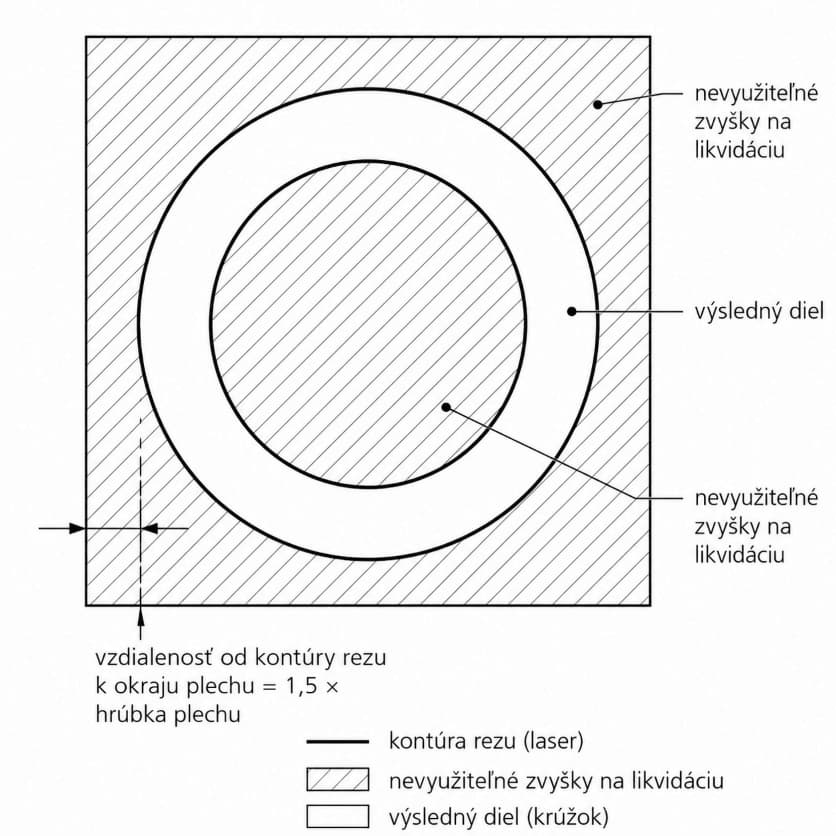
A typical example is a part shaped like a circular ring or annulus. The finished part is only the ring itself, while the material inside the circle and the material around it both stay behind as unusable scrap.
Technological clearance from the sheet edge
At the same time, laser cutting cannot run all the way to the edge of the sheet. A minimum technological clearance has to remain between the cut contour and the edge of the sheet. In this case:
distance from the cut contour to the sheet edge = 1.5 × sheet thickness
This clearance matters for cutting stability, safe guidance of the cut and reliable processing of the material. This technical requirement, too, affects the overall use of the sheet.
What costs unusable offcuts create
A larger amount of scrap does not just mean higher material consumption. Production also incurs further costs directly tied to it:
- Handling the offcuts. Once the parts are cut, the offcuts have to be separated, moved and prepared for further processing or disposal. That means more time and labour.
- Storing the offcuts. Not every offcut is disposed of straight away. Some are kept in case they can be used on later jobs. With irregular or small offcuts, however, the chance of reuse is considerably lower.
- Disposal costs. When offcuts can no longer be used, costs arise for sorting, removing and disposing of them.
- Storing non-standard sheet offcuts. Irregular parts often leave pieces of sheet in non-standard sizes. Such offcuts are harder to record, store and slot into future jobs.
- Risk of degradation during long storage. If offcuts are stored for too long, they can:
- warp,
- be damaged during handling,
- corrode or rust,
- become unusable.
This means that even an offcut originally set aside for possible reuse may later end up as waste destined for disposal.
Why this affects the price of the part
When laser cutting is quoted, the cut length alone is therefore not the only thing assessed. An important role is also played by:
- the shape of the part,
- the use of the material,
- the number of internal cut-outs,
- the volume of unusable offcuts,
- whether or not the leftover material can be reused.
The less efficient a part is in terms of sheet usage, the more not only the material costs grow, but also the production and logistics costs connected with the offcuts.
Conclusion
In laser cutting, the deciding factor is not only the size of the finished part, but also how that part “behaves” across the area of the sheet. Parts with irregular shapes or large internal cut-outs naturally create more scrap, and with it raise the total cost of production.
For the customer that means one important thing: if the goal is to optimise the price, it pays to consider not just function and appearance at the design stage, but also the efficiency of material usage.
At LASERCUT we always assess a job from the perspective of technological feasibility and material usage too, so that we can propose the most efficient production solution.